Geogrid vs. Geotextile
They look similar but they do completely different jobs. Geogrid stabilizes aggregate mechanically. Geotextile separates and filters. Here's how to pick — and when you need both.
Side-By-Side
| Feature | Geogrid | Geotextile |
|---|---|---|
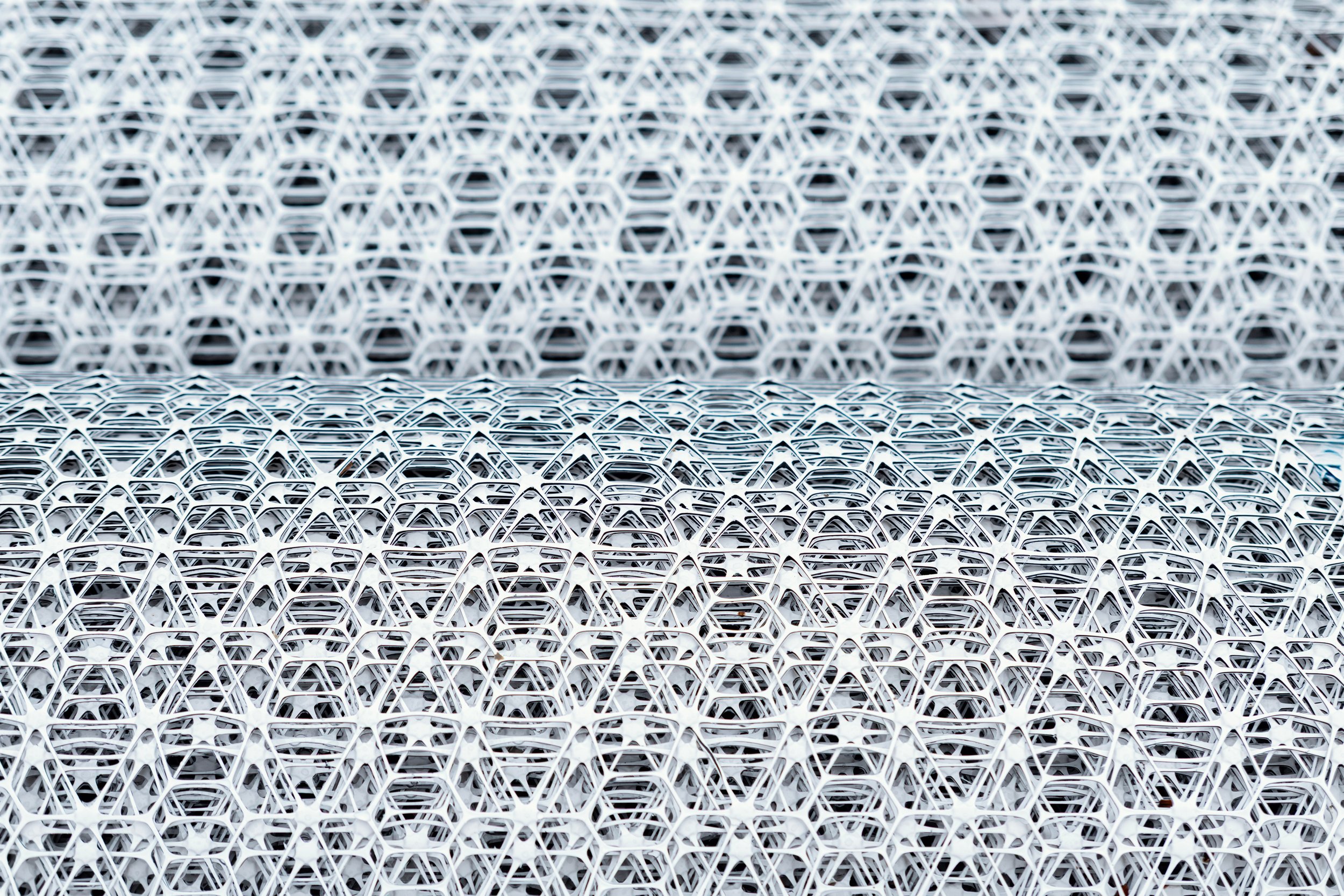
| What it looks like | Plastic grid with open apertures | Woven fabric or fluffy mat |
| Primary job | Mechanically stabilize aggregate | Separate and filter |
| How it works | Stones lock through openings | Blocks soil, passes water |
| Best for | Load-bearing aggregate layers | Soil separation, drainage, filtration |
| Typical use | Under driveways, parking lots, roads | Under geogrid on soft ground, French drains, retaining walls |
| Brand examples | Tensar InterAx, TriAx | Mirafi 500X/600X (woven), 135N/140N/180N (nonwoven) |
| Where it sits | Between subgrade and aggregate | Below geogrid on soft soil, or in drainage systems |
| Replaces excavation? | Often yes on soft ground | Prevents soil migration, extends aggregate life |
The Decision Tree
Building a driveway, road, or work pad?
→ You need geogrid for mechanical stabilization.
Is the subgrade soft, wet, or clay-heavy (CBR under 3)?
→ Add woven geotextile below the geogrid as a separator.
Building a French drain or drainage system?
→ Nonwoven geotextile (135N/140N/180N) — no geogrid needed.
Retaining wall backfill or planter drainage?
→ Nonwoven geotextile as a filter layer.
Under a stone-mulch decorative bed?
→ Woven geotextile as a weed barrier that still lets water through.
FAQ
What's the actual difference between geogrid and geotextile?
Geogrid is a grid — think a plastic mesh with open square or triangular apertures that aggregate can lock through. Its job is to mechanically stabilize aggregate by locking stones into the openings so they can't migrate. Geotextile is a fabric — either a tightly woven pattern (like Mirafi 500X) or a fluffy nonwoven mat (like Mirafi 135N). Its job is to separate two materials from each other and filter water while blocking soil particles.
When do I need geogrid?
Any time you're building a load-bearing aggregate layer — driveway, road, work pad, parking lot, construction site access — on soft or marginal subgrade. Geogrid turns loose aggregate into a stiff, load-spreading platform. Without it, aggregate on soft ground migrates, ruts, and pumps mud within a season.
When do I need geotextile?
Whenever two dissimilar soils or materials need to stay separated: aggregate over soft clay (separation), a French drain (filtration), behind a retaining wall (drainage), or under a stone-mulch bed to stop weed growth. Woven geotextiles like Mirafi 500X/600X are for separation under load. Nonwoven geotextiles like 135N/140N/180N are for drainage and filtration.
Do I need both?
On soft ground, yes — that's the two-layer system. Woven geotextile on the subgrade to stop soft soil from pumping up into your aggregate. Geogrid on top of the fabric to lock the aggregate into a stiff platform. Aggregate over the geogrid, compacted. This is how you build permanent driveways and access roads over ground you couldn't walk across in mud season.
Can geogrid alone handle soft ground?
Sometimes, but not always. Geogrid stabilizes the aggregate above; it doesn't stop the soft soil below from squeezing up into that aggregate. On soils with CBR under 3, aggregate placed directly on the subgrade without a separator will eventually contaminate — even with geogrid holding the top layer in place. That's when you add the woven geotextile as a bottom layer.
How do I know which product to buy?
Two data points: your subgrade condition and your traffic load. Tell us how soft the ground gets in wet weather and what will drive across it, and we'll spec the exact geogrid, aggregate thickness, and separation-fabric requirement. Tensar's engineering software (free with our material) handles the design.
Still Not Sure?
Call us. Free design help from Tensar's engineering team included with every material order.