Every spring, the same calls come in from Cleveland, Akron, and Canton: a parking lot that looked fine in October is now alligator-cracked, a driveway has a hump down the middle, a service road is pumping water through every joint. The damage looks like it happened overnight. It did not. It was set up months earlier, when the ground froze.
This post covers what is actually happening in Northern Ohio subgrades during freeze-thaw cycles, why the soils here are uniquely vulnerable, and where geogrid does — and does not — help.
The Three Ingredients of Frost Heave
Frost heave is not just "ground freezing." It requires three conditions to occur together. Remove any one and frost heave largely stops:
- Freezing temperatures sustained long enough for the frost line to penetrate into the subgrade.
- A frost-susceptible soil — typically a silt or silty clay with fine enough pores to support capillary water movement, but not so fine that water cannot flow at all. The U.S. Army Corps of Engineers ranks silts (ML), silty clays (CL-ML), and similar fine-grained soils among the most frost-susceptible classifications.
- A water source — usually a shallow groundwater table or perched water that can feed the freezing front through capillary action.
When all three are present, water is pulled upward toward the freezing zone and freezes into discrete ice lenses that grow horizontally. Those lenses displace the soil above them — that is the "heave" you see on the surface. Heave of several inches over a single winter is well-documented in the engineering literature.
Why Northern Ohio Checks All Three Boxes
Cuyahoga, Summit, Stark, Lorain, and Mahoning counties sit on glacial till deposited by the Wisconsin and Illinoian glaciations. The result is a landscape dominated by silt loams, silty clay loams, and clay loams — exactly the soil textures that fall into the most frost-susceptible categories.
You can confirm this for any specific site using the USDA Natural Resources Conservation Service's Web Soil Survey. For most of the urbanized Northern Ohio corridor, the dominant map units describe silty, low-permeability soils with seasonally high water tables. That is a textbook frost-susceptible profile.
Layer on a sustained winter with frost penetration that commonly reaches into the 20-to-30+ inch range in Northern Ohio, and a water table that is rarely deep enough to matter, and you have all three ingredients sitting under most of the region's parking lots, driveways, and low-volume roads.
The Real Damage Happens in the Spring, Not the Winter
Here is the part that surprises people: most of the pavement damage you see in April and May was not caused by the freezing — it was caused by the thawing.
Thaw moves top-down. The surface warms first while the deeper subgrade is still frozen. The ice lenses that formed all winter melt into water that cannot drain downward, because the layer below is still frozen solid. That trapped meltwater saturates the upper subgrade and base. Bearing capacity collapses.
This is the period civil engineers call spring breakup or thaw weakening. In states with formal seasonal load restrictions — Michigan, Minnesota, Wisconsin — this is exactly when trucks get told to stay off certain routes. The pavement structure is sitting on what amounts to a saturated sponge. Normal traffic loads cause rutting, pumping of fines, alligator cracking, and base failures that turn into potholes a few weeks later.
Why May matters in Ohio: the visible damage you are seeing right now in Cleveland, Akron, and Canton lots and drives is the spring breakup signature — set up over winter, exposed by the thaw, accelerated by traffic.
What Geogrid Actually Does — and Doesn't Do
Be skeptical of anyone who tells you geogrid "prevents" frost heave. It does not. Geogrid is not a moisture barrier and does not change the capillary behavior of the soil below it. If the three ingredients are present, the soil will heave.
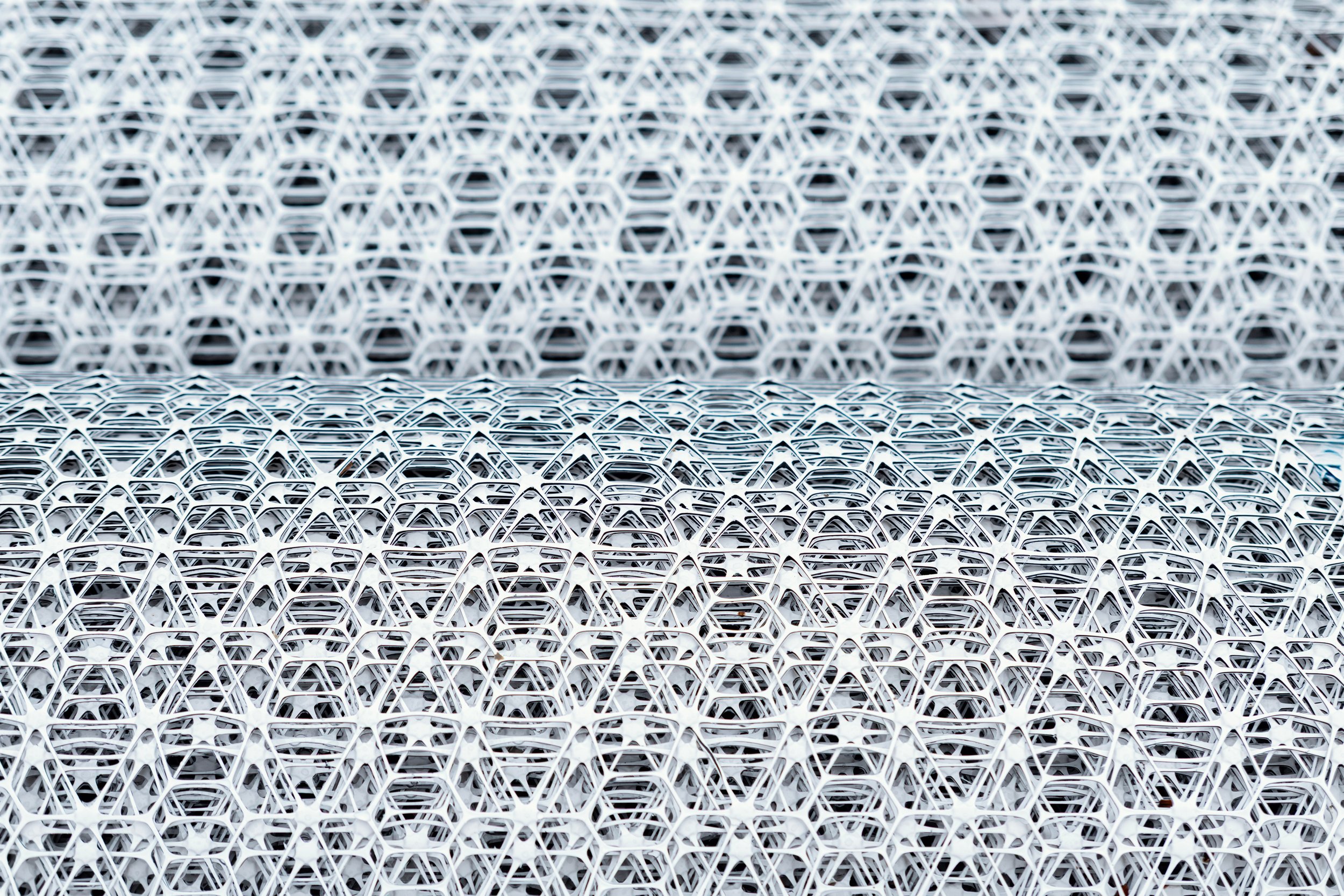
What geogrid does is change the consequences. By mechanically stabilizing the aggregate layer, it:
- Distributes loads over a wider area, reducing the peak stress reaching a weakened spring subgrade.
- Confines the aggregate so it cannot displace laterally or punch into a soft subgrade during the thaw-weakened period.
- Reduces base course intermixing with the subgrade, which keeps the base layer working as a base layer instead of slowly turning into contaminated mud.
- Extends the section's life through multiple freeze-thaw cycles by limiting the cumulative damage each spring breakup adds.
Pair It With a Separator
In silty Northern Ohio subgrades, the most effective freeze-thaw section combines a geogrid (for reinforcement and confinement) with a nonwoven geotextile (for separation and filtration) at the subgrade interface. The geotextile keeps fines from pumping up into the aggregate during the saturated thaw period, while still allowing water to pass. This combination is widely used in cold-region pavement design for exactly this reason.
Where It Pays Off in Northern Ohio
- Commercial parking lots on glacial till — the most common problem we get called about each spring.
- Residential driveways in Cuyahoga, Summit, and Stark counties, where silty clay loam subgrades are the default.
- Low-volume municipal roads where over-excavation is not budget-feasible.
- Industrial yards and haul roads that need to carry heavy traffic through and right after the thaw period.
- Repair sections where last spring's breakup damage is being rebuilt and you do not want to be back in the same spot next May.
Right Now: Patch Packs for the Potholes Already Open
Geogrid is the long-term answer when you are rebuilding a section. But if you are reading this in May and you have potholes already broken open from spring breakup, you need something you can throw down today. That is what Patch Packs are for.
Patch Packs are a cold-applied asphalt repair material — 100% recycled aggregate, VOC-free, no torches and no hot box required. The binder lets the patch compress and expand under traffic instead of popping out the way conventional cold patch often does. Two variants:
- Standard Patch Packs — general-purpose pothole and utility-cut repair on roads, lots, and driveways.
- Flex Patch Packs — formulated for bridge decks, expansion joints, and any surface that flexes under load.
Patch Packs do not fix the underlying subgrade problem that caused the pothole — only a proper base rebuild does that. But they buy you the rest of the season to plan and budget the real repair, and they hold up far better than throwing cold mix from a bag.
Before You Overlay This Fall: Treat the Cracks With an Interlayer
Here is the trap a lot of property owners fall into: spring breakup damages the surface, summer brings an overlay, the new asphalt looks great for a winter or two, and then the same cracks come right back through. That is reflective cracking — the underlying cracks "telegraphing" up through the fresh overlay because nothing was done to stop them.
In a freeze-thaw climate this is especially destructive. Once a reflective crack opens, water gets in, and water in the base is exactly what starts the next freeze-thaw failure cycle. You are paying for an overlay and then funding its own destruction.
A paving interlayer like Propex Petrotac is the standard answer. It is a self-adhesive membrane placed between the existing pavement and the new overlay. It does two things at once:
- Stress relief — absorbs movement at joints and cracks so it does not transfer into the new overlay.
- Moisture barrier — blocks water from infiltrating the base, which is what feeds the next round of freeze-thaw damage.
We stock Petrotac in three widths so the roll matches the scope of the distress:
- Petrotac 1ft (12 in) — individual transverse and longitudinal cracks, joints, and spot treatment. The most economical option for narrow distress.
- Petrotac 1.5ft (18 in) — wider cracks, expansion joints, and areas with parallel cracking that need a bit more overlap.
- Petrotac 4ft (48 in) — broad cracking patterns, lane-segment overlays, and large patch perimeters where a wider strip cuts roll count and seams. New width, in stock.
The 1ft is usually the right answer when an owner calls about "crack sealing" on a lot that is going to be overlaid later — Petrotac does more than a hot-pour crack seal because it also blocks moisture into the base. All three are sold at the supply house for contractors to install themselves.
Different product, different scope — need it installed? Petrotac is peel-and-stick and meant for contractors to apply themselves. The other type of paving fabric interlayer — non-peel-and-stick paving fabric laid with a hot asphalt tack coat over large areas like parking lots and roads before overlay — is what our sister company Asphalt Fabrics & Specialties installs in Northern Ohio. They also handle crack sealing and chip sealing. Different product than what we stock, same family, same region. Reach them at (440) 249-6717.
The Three-Layer Strategy for Freeze-Thaw Climates
Put it all together and Northern Ohio property owners and contractors have a repeatable playbook:
- Right now (spring): Patch Packs on open potholes to stabilize the surface and stop further damage.
- Before fall overlay: Petrotac interlayer over existing cracks and joints so the new surface does not inherit them.
- When the section actually gets rebuilt: Geogrid (with a nonwoven separator) in the base so the next freeze-thaw cycle does not put you back in the same place.
Each layer addresses a different piece of the freeze-thaw problem. Skipping one is usually what causes the same lot to keep failing.
A Note on Verification
The frost-susceptibility classifications cited above come from the U.S. Army Corps of Engineers and are referenced in standard FHWA pavement design guidance. Site-specific soils information for any address in Northern Ohio is available through the USDA-NRCS Web Soil Survey. Geogrid product specifications follow ODOT Construction & Material Specifications Item 712 and manufacturer datasheets — we can pull the relevant spec for any project on request.
Building or Repairing After This Spring's Damage?
We'll run an on-site DCP test on your subgrade, identify your soil's frost susceptibility, and design a geogrid + geotextile section that holds up through the next freeze-thaw cycle. No guesswork — engineered for Northern Ohio conditions.